WSL Fantasy Guide: Tips, Rules and Strategy
WSL Fantasy is the official free game of the Barclays Women's Super League, and it is not a re-skin of Fantasy Premier League. Uncapped involvement points, a season split into six Legs, two Free Hits instead of a Bench Boost, and substitution windows between match days make it a genuinely different game to play well. This guide covers everything you need for the 2026/2027 season — the rules, the scoring, and the strategy that actually moves you up your mini-league — whether this is your first fantasy game or your tenth.
What is WSL Fantasy and how does it work?
You build a 15-player squad, pick 11 starters for each matchweek and captain one of them for double points. Your players score from what they actually do in Barclays WSL matches, measured by Opta. The 2026/2027 season runs across 26 matchweeks, starting on 4 September 2026, with 14 clubs and seven matches per round.
The squad
- 15 players: 2 goalkeepers, 5 defenders, 5 midfielders, 3 forwards
- Budget: £100 million
- Maximum 3 players from any one club — and your bench counts towards that limit
- Formation: 11 starters and 4 substitutes. Any shape with 1 goalkeeper, at least 3 defenders, at least 2 midfielders and at least 1 forward.
Prices are tighter than in FPL. In our database the whole player pool runs from £4.0m to £12.5m: goalkeepers top out at £5.5m, defenders at £8.0m, midfielders at £8.5m, and only forwards go higher. That compression matters — there is no £15m superstar to build around, so the difference between a good squad and a bad one is usually made in the £4.5m–£6.5m band.
The scoring system
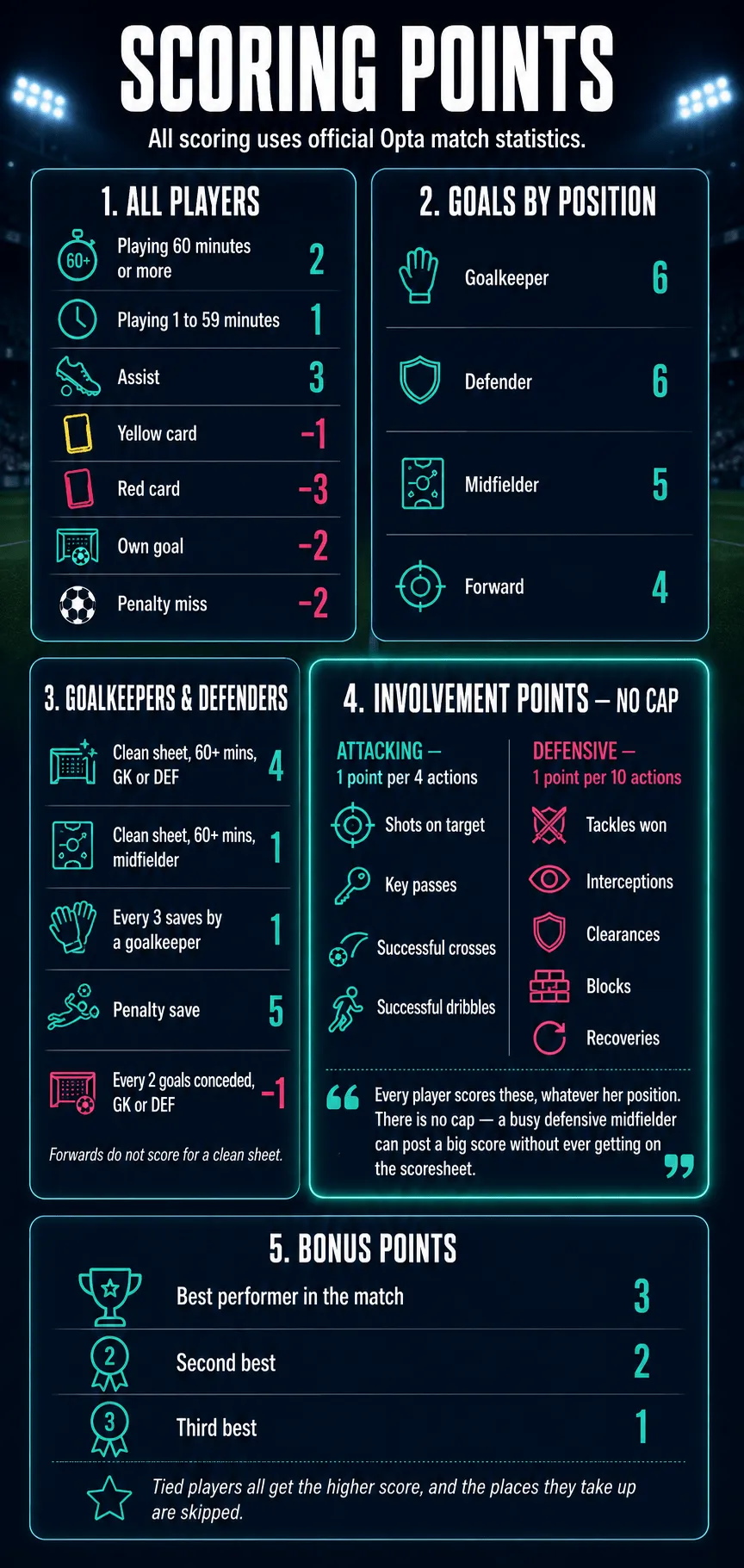
All scoring is taken from Opta data. The headline numbers look familiar if you have played FPL, with one big exception that we cover in the next section.
| Action | Points |
|---|---|
| Playing 1–59 minutes | 1 |
| Playing 60+ minutes | 2 |
| Goal — forward | 4 |
| Goal — midfielder | 5 |
| Goal — defender or goalkeeper | 6 |
| Assist | 3 |
| Clean sheet (60+ mins) — goalkeeper or defender | 4 |
| Clean sheet (60+ mins) — midfielder | 1 |
| Every 3 saves by a goalkeeper | 1 |
| Penalty save | 5 |
| Every 4 attacking actions | 1 |
| Every 10 defensive actions | 1 |
| Bonus points (3 / 2 / 1 per match) | 1–3 |
| Yellow card | -1 |
| Red card | -3 |
| Own goal | -2 |
| Penalty miss | -2 |
| Every 2 goals conceded — goalkeeper or defender | -1 |
A few details that decide close mini-leagues. Forwards get nothing for a clean sheet, so a striker in a 0-0 has a hard floor of 2 points. A player sent off keeps the points she had already earned and takes the -3 on top. Assists follow Opta's definition: winning a penalty counts as an assist if the penalty is scored, winning a free kick does not count at all, and nobody is credited for an opponent's own goal.
Bonus points are awarded 3 / 2 / 1 to the three best performers in each match, and ties are generous. If two players tie at the top, both get 3 and the next player down gets 1 — second place is skipped. If three or more tie at the top, they all get 3 and no further bonus is awarded in that match. Two players tied for second both get 2, and no third bonus is given.
Involvement points: the rule that changes everything
This is the single biggest difference between WSL Fantasy and FPL, and it applies to every player regardless of position:
- 1 point for every 4 attacking actions — shots on target, key passes (chances created), successful crosses and successful dribbles
- 1 point for every 10 defensive actions — tackles won, interceptions, clearances, blocked shots and recoveries
There is no cap. That word is doing all the work. FPL's defensive contribution rule pays out once, the moment a player crosses a threshold, and everything she does after that is worth nothing. In WSL Fantasy the counter keeps running: a centre-back who racks up 30 defensive actions banks 3 points, and a busy defensive midfielder can post a big score in a game where she never comes near the scoresheet.
The practical consequence is that volume is a scoring category in its own right. In FPL you buy defenders for clean sheets and hope for a set-piece goal. Here you can buy a defender purely because she plays 90 minutes for a team that spends the game defending, and she will pay you whether or not the clean sheet arrives. That flips the usual logic: defenders at mid-table and bottom-half clubs are genuinely investable, not just cheap enablers.
Our projections model both buckets. To put numbers on it, these are the defensive-action volumes our model projects for the opening matchweek:
| Player | Club | Price | Projected defensive actions (MW1) | Owned |
|---|---|---|---|---|
| Ashleigh Neville | Charlton | £5.0m | 15.8 | 1% |
| Ruby Mace | Everton | £5.5m | 12.8 | 13% |
| Maya Le Tissier | Manchester United | £6.0m | 12.6 | 39% |
| Eva Nyström | West Ham United | £4.0m | 12.4 | 0% |
| Grace Fisk | Liverpool | £5.0m | 11.4 | 6% |
Two caveats. Our metric counts every tackle where the game counts tackles won, so treat these as a close upper bound. And they are a floor in the sense that matters: Neville at £5.0m is projected to clear the 10-action bar in a typical week and to go well past it in her busiest games — one to two points every week before a single tackle turns into a clean sheet or a header. She is owned by 1% of managers. That is what an uncapped rule does to player valuation.
Substitutions and match days: the trap almost everyone falls into
WSL Fantasy has two kinds of substitution — the ones you make, and the ones the game makes for you — and they do not coexist.
The changes you make
Between match days inside a matchweek you can change your starting XI, reorder your bench and switch your captain. A match day runs from the first kick-off that day to the final whistle of the last match that day; your window opens when a match day ends and closes when the next one kicks off. A Friday–Saturday–Sunday round therefore gives you two windows.
Matchweek 1 is a perfect example: London City Lionesses host Manchester United on Friday evening, Chelsea host Aston Villa on Saturday afternoon, and the remaining five matches are all played on Sunday. Two windows, and then everything locks. Note also that Brighton–Arsenal and Tottenham–West Ham kick off at the same time on that Sunday — you cannot make changes between two matches on the same day, however many hours apart they are.
Two rules govern what you can actually do:
- You can bench a player who has already played, but you give up her points. Only your final XI scores.
- You can only bring in a player who has not played yet.
So benching your Friday striker who returned 1 point for a Sunday striker is a real gamble: if the Sunday player is dropped or pulls out in the warm-up, that slot gives you nothing at all.
The changes the game makes for you
Automatic substitutions run after every match in the matchweek has finished, and they follow strict rules: a player who played any minutes at all is never subbed out, a substitute must have played herself to come on, goalkeepers are only replaced by goalkeepers, and outfield players come on in bench order — but only if your XI still satisfies its minimum of 3 defenders, 2 midfielders and 1 forward.
Here is the trap. Making any manual change turns off automatic substitutions for the rest of that matchweek. Not just a substitution — reordering your bench counts, and changing your captain counts too. Switch the armband on Saturday morning, then have two Sunday starters left out in real life, and nobody comes on for them. If you are going to touch your team mid-matchweek, you have taken responsibility for the whole XI from that point on.
Two more things worth knowing before your first deadline. Once a player has kicked off she cannot enter your XI again that matchweek, and if she is your captain the armband is locked on her. And automatic substitutions never move the captaincy: there is no vice-captain in this game, so if your captain does not play at all, no double is applied to anyone. Check our WSL predicted lineups before the deadline — a rested captain is simply a wasted armband here.
Transfers and the six-Leg season
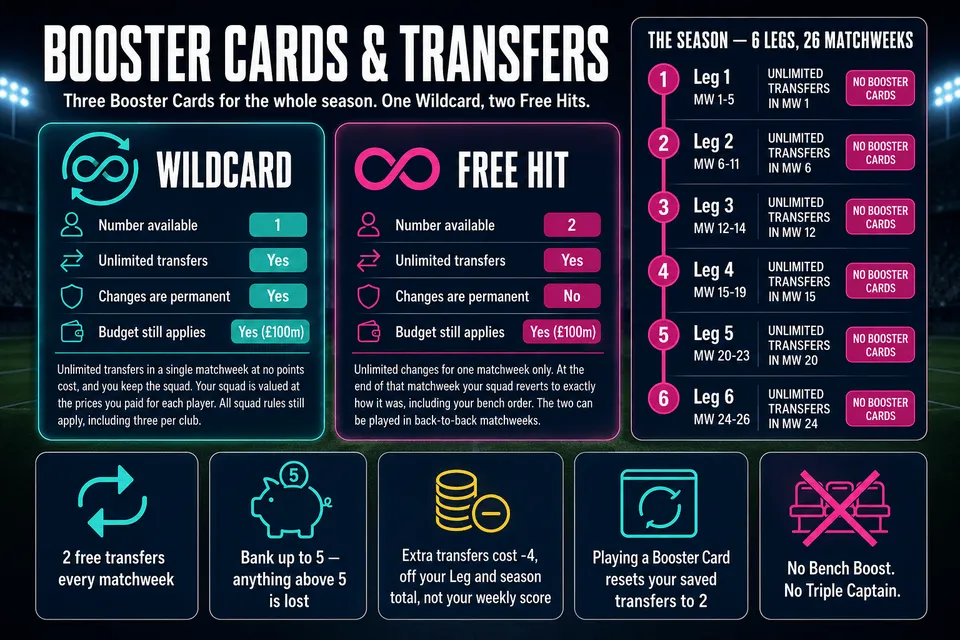
You get 2 free transfers every matchweek, and they bank — but only up to a maximum of 5. Anything above 5 is lost, so sitting on a full bank and making no moves is actively wasteful. Extra transfers cost 4 points each, and the accounting is unusual: the cost does not come off your weekly score, which always shows what your players really scored. It comes off your Leg total and your season total.
The season is divided into six Legs, and the first matchweek of every Leg gives you unlimited free transfers automatically — nothing to activate, nothing to remember:
| Leg | Matchweeks | Unlimited transfers |
|---|---|---|
| 1 | 1–5 | MW 1 |
| 2 | 6–11 | MW 6 |
| 3 | 12–14 | MW 12 |
| 4 | 15–19 | MW 15 |
| 5 | 20–23 | MW 20 |
| 6 | 24–26 | MW 24 |
This creates a transfer rhythm that does not exist in FPL, and it is worth building your season around. Two things reset your saved transfers back to 2: the unlimited matchweek at the start of each Leg, and playing a Booster Card. So banking transfers early in a Leg is smart — it lets you make a double move when an injury and a fixture swing land in the same week. Banking them late in a Leg is throwing them away, because the free rebuild is coming anyway and your bank is about to be wiped.
Practically: in the last matchweek of a Leg — 5, 11, 14, 19 and 23 — you should be spending down towards zero, and you should be far more willing to take a -4 in the middle of a long Leg (Leg 2 runs six matchweeks) than in a short one like Leg 3 or Leg 6, where the free reset is only a week or two away.
Booster Cards: one Wildcard, two Free Hits
You get three Booster Cards for the entire season and no more. There is no Bench Boost and no Triple Captain.
- Wildcard (one per season) — unlimited transfers in a single matchweek with no points cost, and the changes are permanent. Your squad is valued at the prices you paid, and the £100m budget plus every squad rule still applies.
- Free Hit (two per season) — unlimited changes for one matchweek only. At the end of it your squad reverts to exactly what it was, including bench order. The two can be played in back-to-back matchweeks if you want.
Shared rules: one card per matchweek, they cannot be combined, they never expire, playing one resets your saved transfers to 2, and a played card cannot be cancelled. Crucially, a Booster Card cannot be played in an unlimited transfer matchweek — in MW 1, 6, 12, 15, 20 and 24 they will not even be selectable, which is fair enough given you already have unlimited transfers.
Chip strategy. The Free Hits are the more interesting cards, because the game's price list also includes WSL2 players, and there are six matchweeks in which that half of the pool has no fixture at all. Three of those six already fall inside unlimited transfer matchweeks, which leaves matchweeks 8, 11 and 26 as the blank rounds where a Free Hit is genuinely worth holding for. A Free Hit in a blank week lets you field 11 players who actually play, then hand the squad straight back. Hold the Wildcard for a permanent problem instead: a squad that has drifted out of shape mid-Leg, a run of injuries, or a real change in which clubs are good — and remember it is only worth playing in a matchweek where you were not already getting unlimited transfers for free.
How to win: core strategy
1. Concentrate your budget where the model says the points are
Price compression cuts both ways. Because there is no £15m tier, a genuine elite forward is affordable — and worth it. Our model projects Khadija Shaw (Manchester City, £12.5m) for 43.1 points across the first five matchweeks, which is 39% clear of the next-best forward and the single biggest edge available anywhere in the game. When one player is that far ahead, the question is not whether you can afford her; it is which two mid-price players you are downgrading to fit her in.
2. Respect the 3-per-club cap — the bench counts
Manchester City and Chelsea are the two strongest clubs by our numbers over the opening five rounds, with average win probabilities of 69% and 67% and clean-sheet chances of 39% and 41%. You will want to stack them, and the cap will stop you at three each — including anyone sitting on your bench. Spend those slots on the highest-ceiling players at each club rather than on a cheap fourth-choice defender you will never start.
3. Buy minutes and involvement, not just goals
Because involvement points are uncapped, a nailed-on 90-minute defender at a defensive club has a floor that a rotation-risk attacker at a big club does not. Two points for the minutes, one or two for defensive actions, and a clean sheet whenever it comes, is a perfectly good week from a £5.0m player. Build the back half of your squad from players who are certain to start, and use the underlying WSL player data to check projected minutes before you commit.
4. Treat captaincy as a plan across match days, not a name
The armband locks the moment your captain's match kicks off, and there is no vice-captain to catch you. So there is a real advantage to captaining a player who features on the first match day of a round: if she blanks and you have not touched anything else, you can still move the armband onto a later fixture. Just remember that moving it disables your automatic substitutions for the rest of the week. Our guide to picking a fantasy captain covers the general framework; the WSL twist is that timing matters as much as the pick.
5. Order your bench like it will be used, because it will
With four substitutes and automatic substitutions running strictly by bench order, the order is a decision, not decoration. Put the player most likely to start first. Remember goalkeepers are only swapped for goalkeepers, so your second goalkeeper is insurance and nothing else — which is why almost everyone runs a £4.0m backup and spends the saving in the outfield.
6. Plan the blanks before they arrive
Matchweeks 8, 11 and 26 are the ones to circle. Knowing months in advance which rounds are thin is a bigger edge than it sounds: you can aim your Free Hits at them, avoid taking hits in the weeks beforehand, and check the full WSL fixture schedule to see which clubs are affected and when. Fixture swings matter in the ordinary weeks too — our fixture difficulty rating explainer describes how we turn match odds into a difficulty score.
Where the value is right now, by our model
Our model projects expected points for every WSL player and every matchweek, from expected goals, expected assists, projected minutes, clean-sheet probability and defensive-action volume. These are the standouts for the opening five matchweeks of 2026/2027. Ownership figures are from the official game.
| Player | Club | Pos | Price | Projected pts, MW1–5 | Owned |
|---|---|---|---|---|---|
| Khadija Shaw | Manchester City | FWD | £12.5m | 43.1 | 53% |
| Lauren Hemp | Manchester City | MID | £8.0m | 31.8 | 30% |
| Alessia Russo | Arsenal | FWD | £11.5m | 31.0 | 56% |
| Vivianne Miedema | Manchester City | FWD | £9.0m | 28.0 | 24% |
| Olivia Holdt | Tottenham Hotspur | MID | £7.5m | 26.1 | 5% |
| Ellie Carpenter | Chelsea | DEF | £7.0m | 24.8 | 15% |
| Maya Le Tissier | Manchester United | DEF | £6.0m | 24.0 | 39% |
The best value in the game is cheaper than you think. Points per million is where a £100m budget is won, and the leaders are not the premiums:
- Anneke Borbe (Arsenal, GK, £4.5m) — 20.6 projected points over five rounds, the best return per million in the entire pool, owned by 2%.
- Courtney Brosnan (Everton, GK, £5.0m) — 22.0 projected points, the top goalkeeper outright, at 7% ownership.
- Signe Gaupset (Tottenham, MID, £6.0m) — 24.1 points, more than midfielders costing £2m more, at 4% ownership.
- Madison Haley (Brighton, FWD, £6.5m) — 24.2 points, the best cheap forward in the game, owned by 2%.
- Jayde Riviere (Manchester United, DEF, £5.0m) — 19.9 points from a defence our model rates fourth-best over the opening five rounds.
Compare that with the template. Alessia Russo is owned by 56% and projects 31.0; Shaw is owned by 53% and projects 43.1. The premiums are correctly priced and correctly owned — which means the places you gain on your mini-league come almost entirely from the eight or nine squad slots that everybody fills differently. Start from our WSL player picks, which rank every player by projected points and value, and sanity-check your build against the optimal squad our solver rebuilds live against the latest projections.
These numbers move every time lineups, odds or injuries change, so treat the tables above as a snapshot of the opening rounds rather than a season-long ranking.
Use TheFantasyTool to get an edge in WSL Fantasy
We project expected points for every WSL player and every matchweek, and turn that into tools you can act on:
- Player Picks — the best players to buy for the upcoming matchweek, ranked by projected points and value, filtered by position and price so you can find premiums and budget gems in one place.
- Team Planner — load your own WSL Fantasy squad, test transfers and see how each move changes your projected score before you commit a free transfer or a -4.
- Optimal Teams — the mathematically best squad for a £100m budget, solved live against our latest projections, respecting the 3-per-club cap and every formation rule.
- Predicted Lineups — who our model expects to start, which is the first thing to check before you captain anyone.
- Schedule — the full matchweek-by-matchweek fixture programme, including the match days inside each round.
- Market Probabilities — the win, draw and clean-sheet probabilities behind every projection, straight from the betting market.
Round-by-round analysis lives in our WSL preview hub, and if you want to understand what sits behind the numbers, start with what predicted points actually means or browse all our fantasy football guides.
One honest caveat: the official game pools Barclays WSL and WSL2 players in the same price list. Our model currently covers the Barclays WSL only, so you will not find projections for WSL2 players on our pages yet.
Quick-start checklist
- Pick 2 GK, 5 DEF, 5 MID, 3 FWD inside £100m, maximum 3 per club including the bench
- Fit one genuine premium forward, then find your value in the £4.5m–£6.5m band
- Prioritise nailed-on 90-minute players — uncapped involvement points reward volume
- Captain someone who plays on the first match day so you keep the option to switch
- Never touch your team mid-matchweek unless you are prepared to lose automatic substitutions — a captain change counts
- Bank transfers early in a Leg, spend them before the Leg ends, and never sit above 5
- Save your two Free Hits for the blank matchweeks 8, 11 and 26
- Check Player Picks and the predicted lineups before every deadline
FAQ
When does WSL Fantasy 2026/2027 start?
The season starts on Friday 4 September 2026, when London City Lionesses host Manchester United. There are 26 matchweeks in total, with 14 clubs and seven matches per round, and the season is split into six Legs.
How many transfers do you get in WSL Fantasy?
Two free transfers every matchweek. They bank up to a maximum of 5, and anything above 5 is lost. Extra transfers cost 4 points each, deducted from your Leg total and season total rather than your weekly score. You also get unlimited free transfers automatically in the first matchweek of each Leg: matchweeks 1, 6, 12, 15, 20 and 24.
What are involvement points in WSL Fantasy?
Every player earns 1 point per 4 attacking actions (shots on target, key passes, successful crosses, successful dribbles) and 1 point per 10 defensive actions (tackles won, interceptions, clearances, blocks, recoveries). There is no cap, so a high-volume player keeps scoring all game. It is the main reason cheap, nailed-on defenders at defensive clubs are worth owning: our model has Ashleigh Neville of Charlton, at £5.0m and 1% ownership, projected for around 15.8 defensive actions in matchweek 1.
Why did my substitutes not come on in WSL Fantasy?
Because you made a manual change during the matchweek. Making any change — a substitution, a bench reorder, or even switching your captain — turns off automatic substitutions for the rest of that matchweek. If you touch your team mid-round, you are responsible for the whole XI from that point on.
Which chips does WSL Fantasy have?
Three Booster Cards for the season: one Wildcard and two Free Hits. There is no Bench Boost and no Triple Captain. None of them can be played in an unlimited transfer matchweek (1, 6, 12, 15, 20 and 24), and playing one resets your saved transfers to 2.
Who is the best captain pick in WSL Fantasy?
Over the opening five matchweeks our model has Khadija Shaw of Manchester City clear at the top, projecting 43.1 points at £12.5m, 39% ahead of the next-best forward. Lauren Hemp and Alessia Russo are the closest alternatives. Captaincy changes round by round with the fixtures, so check the current WSL player picks before each deadline.
This guide was written by TheFantasyTool AI - verified by Nicolai @ TheFantasyTool