FPL Tips: Fantasy Premier League Strategy Guide
Introduction
Fantasy Premier League (FPL) is one of the most popular fantasy sports games in the world, with over eleven million managers competing each season. Whether you are new to FPL or a seasoned veteran sharpening your approach, this guide covers the core FPL tips and strategic principles that stand the test of time — regardless of the current season or gameweek.
Success in Fantasy Premier League is rarely about finding the hot pick of the week. It is about building a consistent system: making smart structural decisions, using your chips at the right moments, and avoiding the reactive moves that most managers regret. Get the fundamentals right and good ranks follow.
The core philosophy of a good FPL manager
The best FPL managers share a few traits:
- They play the fixtures, not just the players. A decent player in a great run of fixtures will usually outperform a great player in a tough run.
- They avoid knee-jerk transfers. One blank week does not mean a player is finished, and one big score does not mean a player is worth panic-buying.
- They think in blocks, not individual gameweeks. Planning four to six gameweeks ahead — especially around Double Gameweeks and chip deployment — is what separates the top managers from the rest.
- They protect their resources. Banked free transfers and a clean bench give you the freedom to attack when an opportunity appears. As one elite manager puts it: put yourself in a position to get lucky without putting yourself in a position to get burned.
How Fantasy Premier League works: rules and scoring
You manage a squad of 15 players — 2 goalkeepers, 5 defenders, 5 midfielders and 3 forwards — built within a £100.0m budget, with a maximum of 3 players from any single club. Each gameweek you pick a starting XI, a captain and a vice-captain. Here are the mechanics that shape every strategic decision.
Scoring
| Action | Points |
|---|---|
| Playing up to 60 minutes | 1 |
| Playing 60+ minutes | 2 |
| Goal — goalkeeper | 10 |
| Goal — defender | 6 |
| Goal — midfielder | 5 |
| Goal — forward | 4 |
| Assist | 3 |
| Clean sheet — goalkeeper or defender | 4 |
| Clean sheet — midfielder | 1 |
| Defensive Contribution — defender (10+ CBIT) | 2 |
| Defensive Contribution — midfielder/forward (12+ actions) | 2 |
| Every 3 saves (goalkeeper) | 1 |
| Penalty save | 5 |
| Bonus Points System (per match, top performers) | 1–3 |
| Every 2 goals conceded (goalkeeper/defender) | -1 |
| Penalty miss | -2 |
| Yellow card | -1 |
| Red card | -3 |
| Own goal | -2 |
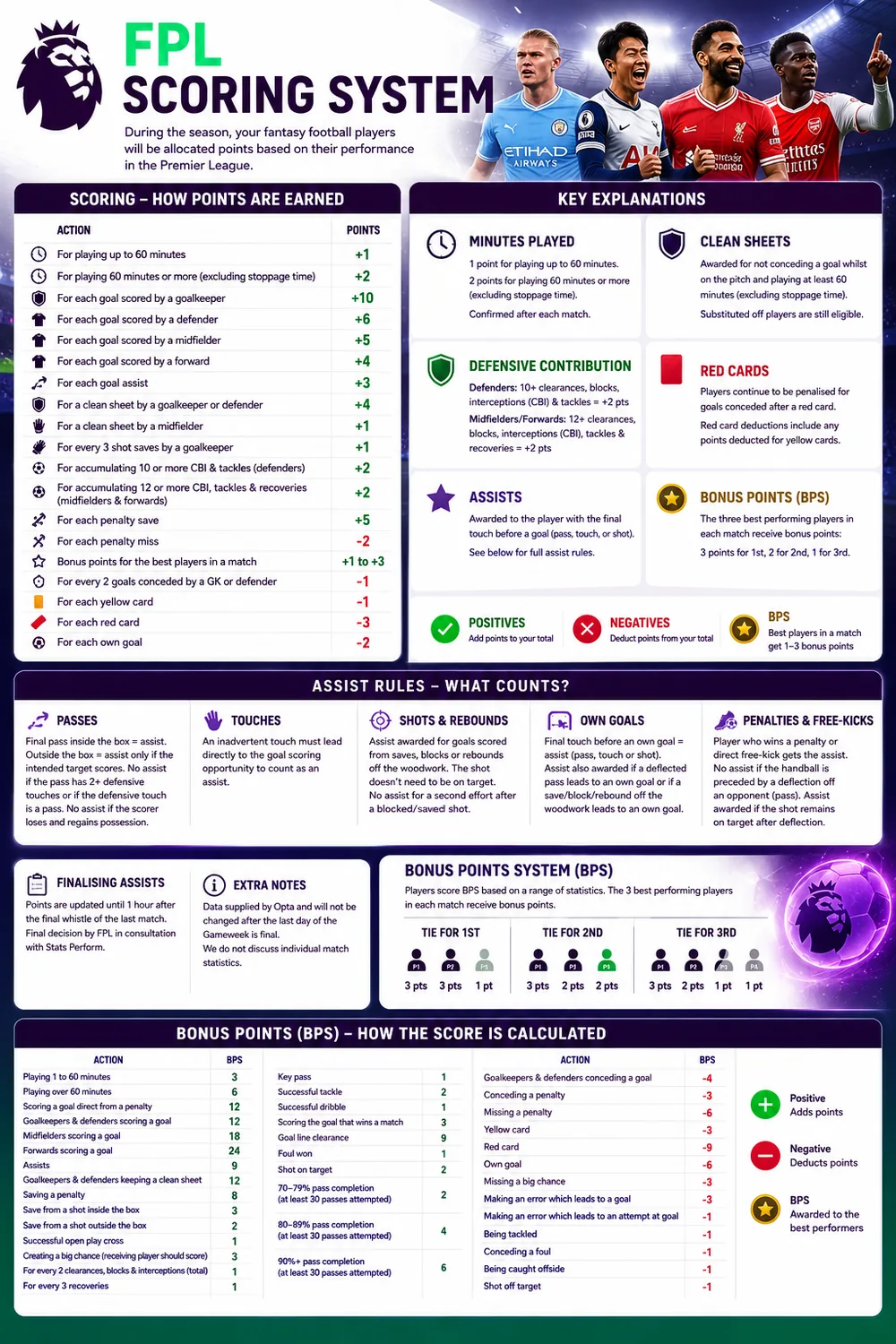
Defensive Contribution (DEFCON) points are the most important rule to understand. Defenders earn 2 points for reaching 10 combined clearances, blocks, interceptions and tackles in a match; midfielders and forwards earn 2 points for reaching 12 defensive actions (those four plus ball recoveries). This single change widened the player pool dramatically — cheap defenders and ball-winning midfielders with little attacking output are now genuinely worth owning.
Transfers
- You get 1 free transfer per gameweek.
- Unused free transfers roll over, and you can now bank up to 5 at a time — saving them up lets you make aggressive multi-move turns from a position of strength.
- Every transfer beyond your free ones costs 4 points (a "hit"). Only take a hit when the expected gain clearly beats it — a Double Gameweek move is a classic example.
Chips (two of each per season)
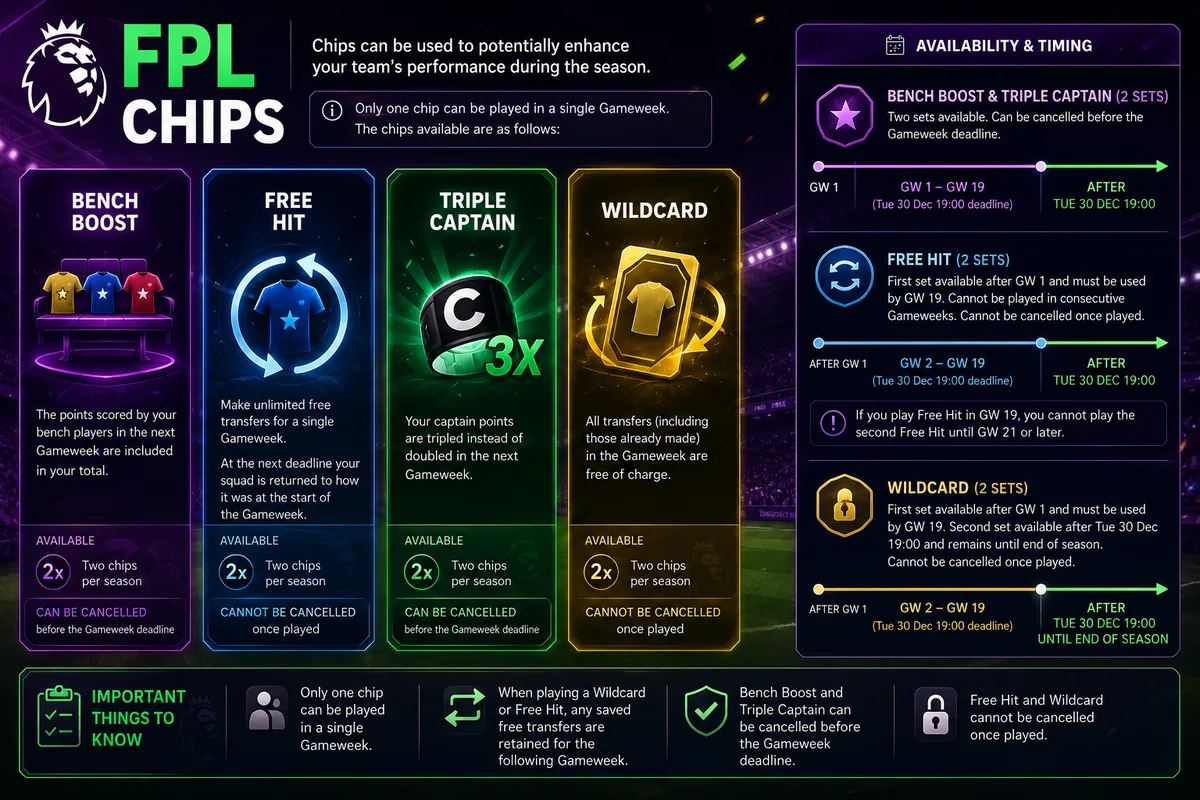
You now receive two of every chip — one usable in the first half of the season (GW1–19) and one in the second half (GW20–38):
- Wildcard (×2): unlimited free transfers for one gameweek, with the new players kept. Your tool for a full rebuild ahead of a strong fixture run.
- Free Hit (×2): unlimited transfers for one gameweek only, then your squad reverts. Best saved for a Blank Gameweek so you can field a full XI.
- Bench Boost (×2): your bench points count too. Best in a Double Gameweek when all 15 players have two fixtures.
- Triple Captain (×2): your captain scores triple instead of double. Save it for the highest-ceiling premium in the best fixture, ideally a double.
Building your FPL team: structure and budget
The most flexible formations are 3-4-3 and 3-5-2, but the principle matters more than the shape: concentrate value in your starting XI and keep a bench that can cover, not a bench that sits dead. A useful budget framework:
- 1–2 premium attackers (£9.5m+): your captain candidates, in your team every week. Do not skimp here.
- 2–3 mid-price enablers (£7–9m): strong underlying numbers and guaranteed starts at a discount to the elite — this is where the real value lives.
- Budget fillers (£4–5.5m): players who start most weeks. Their job is simply not to blank.
Goalkeepers and defenders
Goalkeepers remain the best points-per-million in the game, and a recent boost to their bonus points only helps. Pick a keeper from a team with a strong defensive record rather than the cheapest available. Defenders have closed the gap thanks to DEFCON points — a cheap defender who racks up clearances and tackles can return even without clean sheets, and attacking full-backs who take set pieces add a goal threat on top.
Midfielders and forwards
Midfielders hold most of the captaincy options (the premiums you build around) and a wide value spread, including cheap DEFCON-friendly ball-winners. Forwards are the hardest position to score from after recent bonus tweaks, so most managers invest in just two playing forwards plus a cheap bench option, and lean on midfield and defence for points.
Rotation pairs and bench depth
Bench structure quietly decides seasons. The idea of a rotation pair is to own two cheap players whose good fixtures fall in different weeks, so you always start the one with the better matchup. The math is simple: two players who each return 4 points every week give you 16 over four weeks, but a well-chosen rotating pair that returns 5 or 3 in perfect rotation gives you 20 for the same money. Aim for no more than one truly "dead" player who never starts.
Captaincy strategy
Your captain scores double, so it is the single biggest decision you make each week. A few principles:
- Captain the highest-ceiling player in the best fixture — not automatically your most expensive player.
- Premium home fixtures are almost always preferable to away games.
- Avoid captaining rotation or injury risks, however good their record.
- In Double Gameweeks, captain a player with two fixtures — the ceiling is far higher.
- Plan captaincy over a 5–10 gameweek horizon so your premiums (Salah, Haaland, Palmer and the like) cover as many big weeks as possible. Differential captaincy can move you up fast, but only when it is grounded in a real edge, not a gamble.
Chip timing: the biggest edge in FPL
Because you have two of each chip, the first half of the season is lower-stakes and rewards being proactive; the second half is where Double and Blank Gameweeks make timing critical.
- Wildcard: use it reactively once you have seen who is performing, ideally before a strong fixture swing. The second-half Wildcard is best aimed at the run-in (the final 10–15 gameweeks).
- Free Hit: save for a Blank Gameweek to field a full team, or to break captaincy rotation for one huge fixture. Using it in a normal gameweek is usually a mistake.
- Bench Boost: play it with 15 active players who all have fixtures — this needs your bench planned several weeks ahead. Do not over-build your whole season around it.
- Triple Captain: the highest-ceiling premium in the best fixture, often paired with a Double Gameweek.
Team value and price changes
Player prices rise and fall based on net transfers in and out across the whole game. Getting on a rising player early grows your team value, which over a season buys you more expensive assets than rivals who reacted late. Do not chase price rises blindly — never buy a player you do not actually want just to bank 0.1m — but being slightly ahead of the market is a quiet, compounding edge.
Differentials and the template
The "template" is the set of players the top managers nearly all own. Early in the season, matching the core template protects your rank. Once you are inside the top 500k, differentials become more important, because gaining ground requires owning what others do not. A few rules:
- A differential is only useful with a genuine edge — better fixtures, better underlying stats, or a role change the market has not priced in.
- Do not hold differentials that are not starting consistently. The point is to score when the template blanks.
- Avoid forced differentials: selling a consensus pick because you cannot afford them and pretending the replacement is a differential.
Common FPL mistakes to avoid
- Chasing last week's top scorer. By the time you buy in, the odds favour a regression to the mean.
- Panic-selling a premium after one blank. Elite players return over time — only move on if something structural changed (injury, role loss, rotation).
- Taking too many hits. Every extra transfer costs 4 points — two goals' worth. Make hits count.
- Ignoring fixture difficulty. The same team away at Manchester City versus at home to a promoted side is a completely different proposition.
- Poor bench structure. Your bench should give coverage, not luxury. If your bench never starts, you are wasting value every week.
Use TheFantasyTool to get an edge in FPL
Our model projects expected points for every Premier League player, every gameweek, and turns that into tools you can act on:
Bookmark our previews page — we publish picks and a preview for every gameweek, captain calls and chip timing included.
FPL FAQ
How many chips do you get in FPL?
Eight in total: two each of the Wildcard, Free Hit, Bench Boost and Triple Captain. One of each is available in the first half of the season (GW1–19) and one in the second half (GW20–38).
What are Defensive Contribution (DEFCON) points?
A defender earns 2 points for reaching 10 combined clearances, blocks, interceptions and tackles in a match; a midfielder or forward earns 2 points for reaching 12 defensive actions (those four plus ball recoveries). They reward defensive work and have made cheap defenders and ball-winning midfielders far more valuable.
How many free transfers can you save?
You get one free transfer per gameweek and can bank up to five at once. Extra transfers beyond your free ones cost 4 points each.
What is the best FPL formation?
There is no single best formation, but 3-4-3 and 3-5-2 are the most popular because they concentrate budget in attacking and defensive points while keeping a cheap, functional bench. The right shape changes week to week with your captain and fixtures.
Who should I captain in FPL?
The highest-ceiling player in the best fixture — usually a premium attacker at home, or a player with two games in a Double Gameweek. Check projected points and fixture difficulty before deciding.
Final thoughts
FPL rewards patience, planning and consistency. The managers who rank well year after year do not get lucky every week — they make decisions that give them the best chance of a good outcome, repeatedly. Build around the fundamentals: premium attackers, value defenders and goalkeepers, strong fixtures, smart rotation, and chips at the right time. Good luck this season.