UCL Fantasy Guide: Tips, Rules and Strategy
UEFA Champions League Fantasy (UCL Fantasy) is the official free game from UEFA, and it plays very differently from Fantasy Premier League. Fewer matchdays, a two-night structure, midfield goals worth more than striker goals, and a knockout bracket all reward managers who plan ahead. This guide covers everything you need for the 2026/2027 season — the rules, the scoring, and the core strategy that wins leagues — whether you are a complete beginner or returning for another year.
What is UCL Fantasy and how does it work?
You build a 15-player squad and pick an 11-player starting line-up for each matchday. Your players earn points based on what they do in real Champions League matches, and your captain scores double. The game runs across 17 matchdays: eight in the league phase, then the knockout rounds (play-offs, round of 16, quarter-finals, semi-finals and the final).
The squad
- 15 players: 2 goalkeepers, 5 defenders, 5 midfielders, 3 forwards
- Budget: around €100 million (it rises slightly for the knockout phase)
- Max 3 players from one club in the league phase (this limit increases as the field shrinks: 4 in the round of 16, up to 8 in the final)
- Formation: any valid shape — one goalkeeper, at least three defenders and at least one forward. Start 11, keep 4 on the bench.
The scoring system
Scoring is where UCL Fantasy really differs from FPL. There is no bonus-points system — instead the official Player of the Match earns a flat 3 points. Defensive work and goalkeeping are rewarded heavily, and attacking midfielders are the sweet spot because their goals are worth more than a forward's.
| Action | Points |
|---|---|
| Playing up to 59 minutes | 1 |
| Playing 60+ minutes | 2 |
| Goal — forward | 4 |
| Goal — midfielder | 5 |
| Goal — defender or goalkeeper | 6 |
| Goal scored from outside the box (bonus) | +1 |
| Assist | 3 |
| Clean sheet — goalkeeper or defender | 4 |
| Clean sheet — midfielder | 1 |
| Every 3 saves (goalkeeper) | 1 |
| Penalty save | 5 |
| Every 3 balls recovered | 1 |
| Player of the Match | 3 |
| Winning a penalty | 2 |
| Every 2 goals conceded (GK/DEF) | -1 |
| Conceding a penalty | -1 |
| Missing a penalty | -2 |
| Yellow card | -1 |
| Red card | -3 |
| Own goal | -2 |
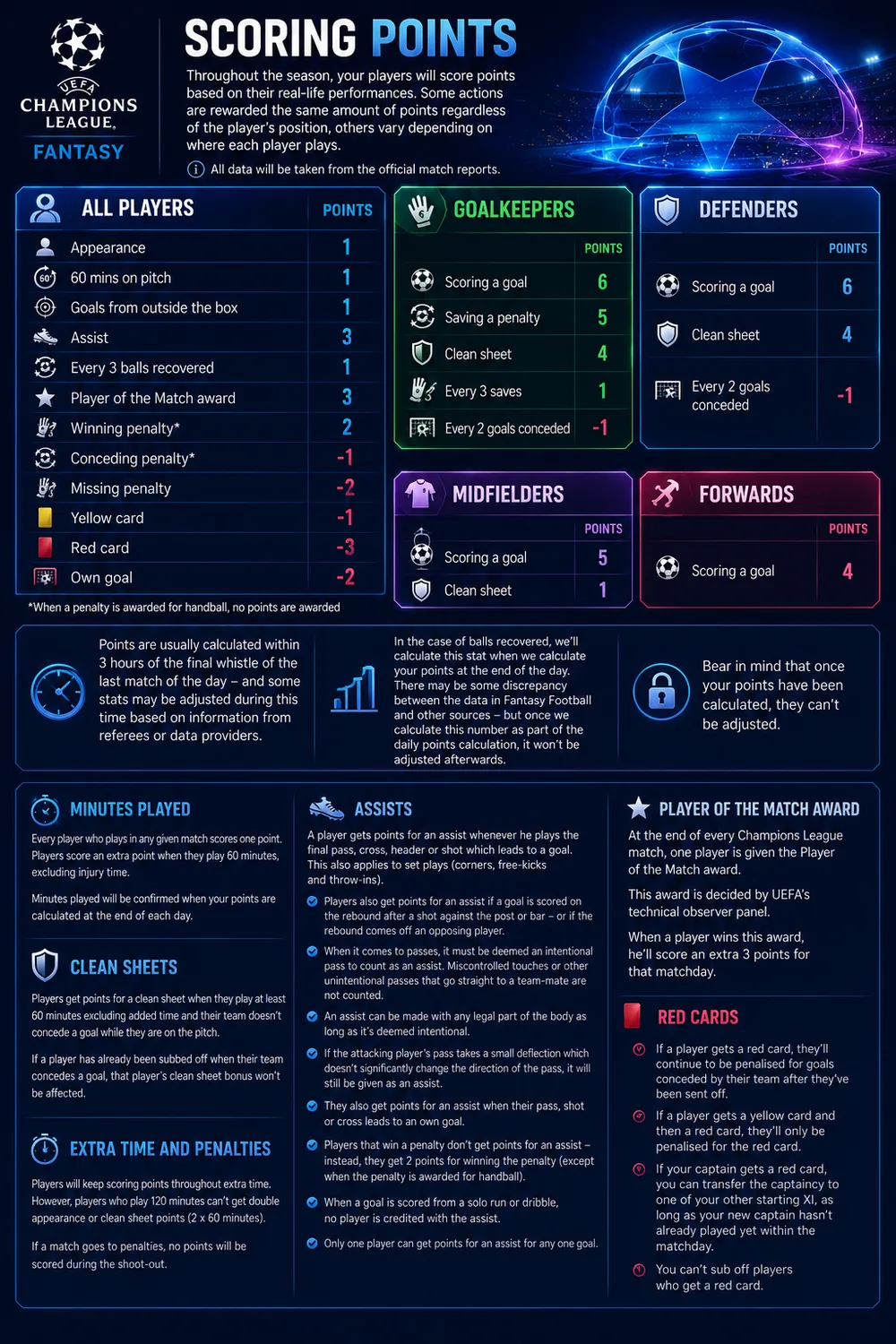
The key takeaway: a midfielder goal (5) beats a forward goal (4), and a defender or goalkeeper goal is worth a massive 6. Attacking midfielders and full-backs who get forward are the engine of a good UCL Fantasy team — they combine goal and assist threat with clean-sheet and ball-recovery points.
The two-matchday twist: stick or twist your captain
This is the single most important thing that separates UCL Fantasy from FPL. Each matchday is split across two nights — usually Tuesday and Wednesday. Once the first night's games finish, you can still make changes before the second night kicks off:
- Switch your captain. If your captain played Tuesday and didn't deliver, you can move the armband to a player whose team features on Wednesday — a fresh shot at double points. Be careful: once you switch, you cannot switch back, and you can only captain a player who hasn't already played.
- Sub off underperformers. You can replace up to 4 starters with bench players whose teams are yet to play. A defender who conceded twice on Tuesday can be swapped for a Wednesday attacker before the second night begins.
Build for the twist. Try to captain a player who plays on the first night — that way, if he blanks, you keep the option to twist onto a Wednesday star. And make sure your bench is split across both nights so you always have live players to sub in.
Your bench actually matters
In many fantasy games the bench is an afterthought. In UCL Fantasy it is a strategic weapon, because you can sub bench players into your XI mid-matchday. A strong, well-spread bench — players from both Tuesday and Wednesday fixtures — gives you live options to react to early results. Order your bench by priority too, so automatic substitutions work in your favour if a starter is benched in real life.
Transfers
- 2 free transfers per matchday during the league phase. You can carry a maximum of one forward to the next matchday.
- Extra transfers cost -4 points each — the same hit principle as FPL.
- Unlimited free transfers are handed out before the big resets: Matchday 1, before the knockout play-offs (Matchday 9) and before the round of 16 (Matchday 11). Use those windows to overhaul your squad for free.
Chips: Wildcard and Limitless
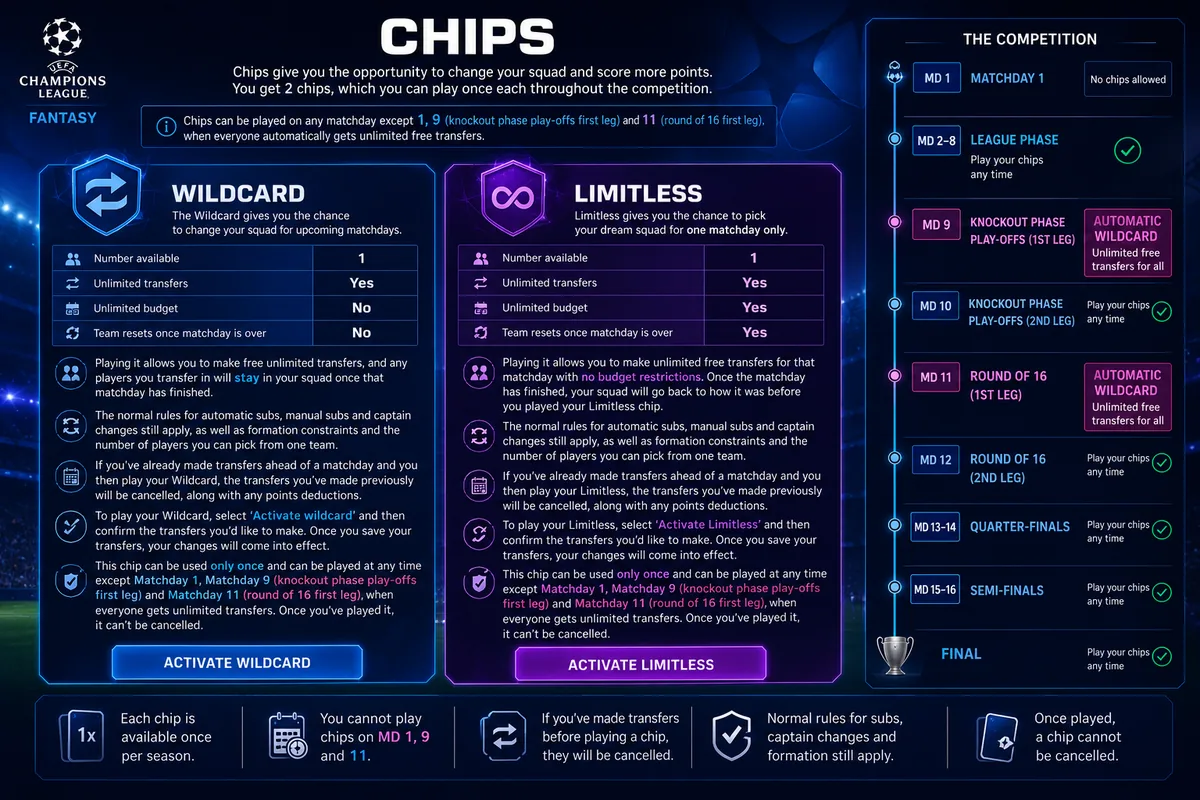
You get two chips, each usable once, and neither can be played on Matchday 1, 9 or 11 (the matchdays you already get unlimited transfers).
- Wildcard — unlimited free transfers for a matchday, and the players you bring in stay in your squad afterwards. This is your tool for a permanent rebuild when the fixtures or your team value have shifted.
- Limitless — unlimited transfers and unlimited budget for a single matchday, after which your squad reverts to what it was. This is a one-night dream team: load up on premiums for a juicy double-favourite matchday, then go back to normal.
Chip strategy. Save Limitless for a matchday where several heavy favourites play strong opponents at home on the same night — you can field a full set of elite attackers you could never normally afford. Save the Wildcard for the knockout stages, when the field narrows, the per-club limit rises, and you want to stack two or three players from the same dominant side permanently.
How to win: core strategy
1. Back the big favourites in the easy fixtures
The Champions League has a steep talent gradient — elite clubs often face opponents they are expected to beat comfortably. Target players from heavy favourites in their best matchups rather than spreading evenly across the field. A defender from a top side at home against a weaker team gives you clean-sheet upside and attacking threat.
2. Chase upside — this is a high-scoring competition
Over the last two seasons, Champions League matches have averaged roughly 3.3 goals per game — higher than almost any major domestic league. That means goals are everywhere, and you should prioritise ceiling over safety. Differential picks with explosive upside win mini-leagues here more than steady 5-point floors do.
3. Treat captaincy as a season-long plan
The captain choice is worth a huge share of your total points. Pick based on the fixture and the two-night structure, not reputation: a first-night captain in a great matchup gives you the points and the twist option. Don't just captain the most obvious name every week — in a high-variance competition, a well-timed differential captain can move you up thousands of places.
4. Plan around two-legged ties
From the knockout play-offs onward, ties are played over two legs. A team chasing a deficit in the second leg can be a goal goldmine; a team protecting a big lead may shut up shop. Read the aggregate situation before you transfer in attackers or defenders for a knockout matchday.
5. Don't waste your free hits
The unlimited-transfer matchdays (1, 9, 11) are free squad rebuilds — line up your big moves for those windows instead of taking -4 hits mid-phase. Patience with transfers is rewarded.
Use TheFantasyTool to get an edge in UCL Fantasy
Our model projects expected points for every Champions League player, every matchday, and we turn that into tools you can act on. Here's what to use:
- Player Picks — the best players to buy for the upcoming matchday, ranked by projected points and value, filtered by position and price so you can find both premiums and budget gems.
- Team Planner — load your own UCL Fantasy squad, test transfers, and see how each move changes your projected score across the next rounds before you commit.
- Optimal Teams — the mathematically optimal squad for your budget, solved live against our latest projections — a perfect starting point or a sanity check on your own team.
- Previews — we publish a fresh matchday preview for every round, with the standout fixtures, the best picks by position and our captain call.
- Schedule — the full matchday-by-matchday fixture programme, so you can plan which favourites have the friendliest runs.
- Fixture Tracker — a colour-coded view of upcoming difficulty for every club, the fastest way to spot who to target and who to avoid.
- Player Data — the underlying numbers (expected goals, expected assists, minutes, clean-sheet probability) behind every projection, so you can dig into the why.
Bookmark our previews page — once UCL Fantasy 2026/2027 is live, we will have a preview and a set of picks for every matchday, captain calls included.
Quick-start checklist
- Pick 2 GK, 5 DEF, 5 MID, 3 FWD within budget, max 3 per club
- Load up on attacking midfielders (5-point goals) and attacking defenders
- Captain a first-night player in a great fixture so you keep the twist option
- Split your bench across Tuesday and Wednesday for live subs
- Make big moves in the free unlimited-transfer windows (MD 1, 9, 11)
- Hold your chips: Limitless for a stacked single night, Wildcard for the knockouts
- Check Player Picks, Optimal Teams and the matchday Preview before every deadline
This guide was written by TheFantasyTool AI - verified by Nicolai @ TheFantasyTool